Why Everyone Is Talking About USDT on TRON (And Why Your Investigator Should Too)
The landscape of digital asset litigation and recovery has undergone a fundamental shift in recent years. While public attention historically gravitated toward Bitcoin and Ethereum, professional investigators have observed a migration of illicit capital toward Tether (USDT) issued on the TRON network (TRC-20). By 2025, TRON had solidified its position as the dominant rail for stablecoin transfers, facilitating over $7.9 trillion in transaction volume. For legal counsel and victims of financial fraud, understanding why this network has become the epicenter of modern crypto fraud investigations is no longer optional — it is a strategic necessity.
The prevalence of USDT on TRON is not a matter of coincidence but a result of deliberate economic incentives. As scammers scale their operations, particularly through "Pig Butchering" or romance-based investment schemes, the underlying blockchain's fee structure and transaction speed become critical operational variables.
The Economic Logic of TRC-20 Adoption
In the context of multi-stage financial deception, the cost of moving assets is a primary concern for the perpetrator. On the Ethereum network (ERC-20), a single USDT transfer can incur gas fees ranging from $10 to $30 during periods of high network congestion. For a scammer managing hundreds of victims, each making multiple deposits, these overhead costs significantly erode the profitability of the enterprise.
Conversely, the TRON network utilizes a delegated Proof-of-Stake (DPoS) architecture that prioritizes high throughput and negligible fees. A typical TRC-20 transfer costs between a few cents and $1, and is often completed in under a minute. This economic efficiency allows scammers to execute a high volume of low-value transfers, which are often used to test a victim's compliance or to "drip-feed" fraudulent returns to build trust.
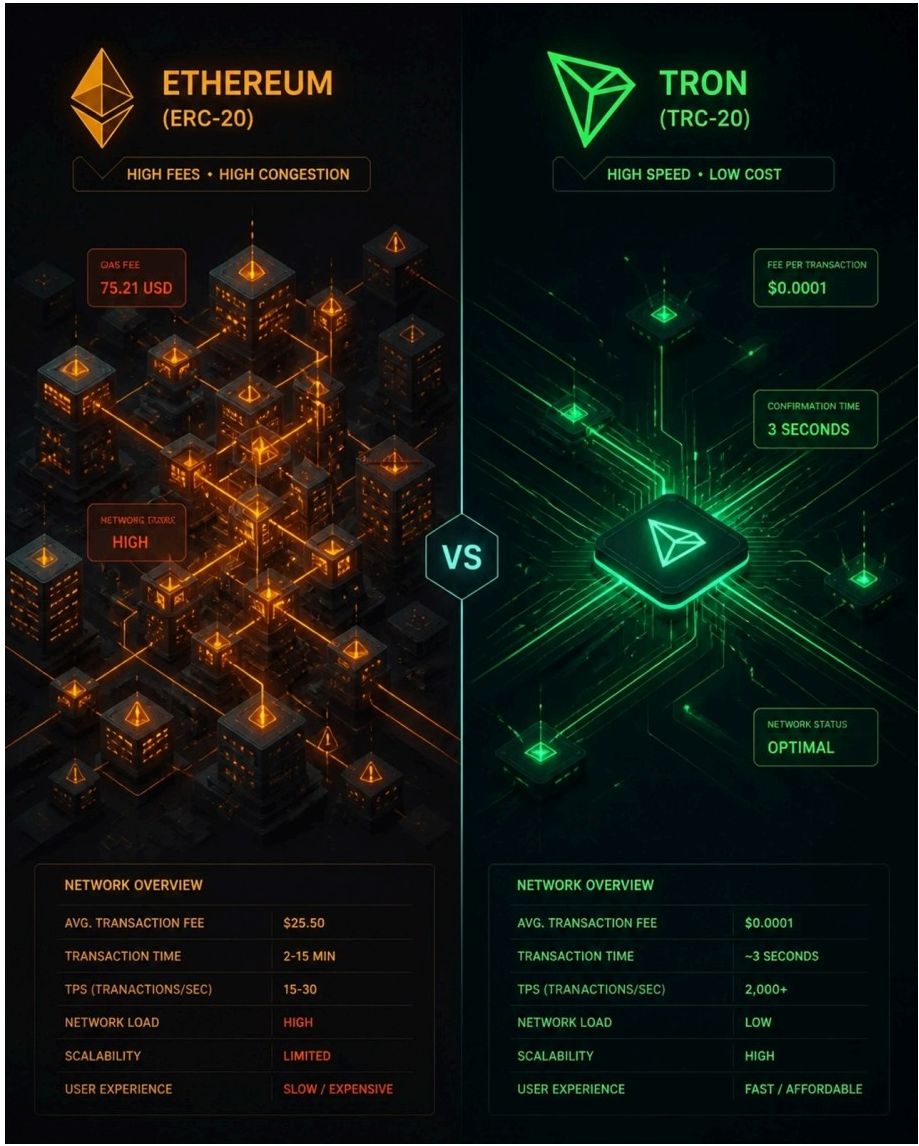
The question for the investigator is not merely if the funds were moved, but why a specific network was chosen. When an investigation reveals a transition from fiat currency to TRC-20 USDT, it often signals an operation designed for high-frequency movement and rapid obfuscation.
Anatomy of the TRC-20 Scam: The "Pig Butchering" Model
"Pig Butchering" (Sha Zhu Pan) represents a sophisticated blend of social engineering and technical exploitation. According to industry reports, pig-butchering revenue grew nearly 40% in 2024, with the number of deposits into these schemes increasing by over 200%. This data suggests that perpetrators are targeting a broader demographic, soliciting smaller individual amounts but at a much higher frequency.
The typical lifecycle of these scams involves: Inducement — the victim is contacted via social media or messaging apps and convinced to invest in a fraudulent platform; Asset Conversion — the victim is directed to purchase USDT through a legitimate exchange; Transfer to TRC-20 — due to lower fees and broad availability on high-risk exchanges, the victim is instructed to send the funds to a TRC-20 address controlled by the scammer; Layering and Consolidation — once on the TRON network, funds are rapidly moved through a series of "mule" wallets before being consolidated into larger "hub" addresses or sent to over-the-counter (OTC) desks for off-ramping into fiat currency.
For legal professionals, the distinction between narrative evidence (what the victim was told) and digital evidence (the actual flow of USDT on TRON) is paramount. A professional cryptocurrency tracing effort focuses on documenting these "service touchpoints" where the digital asset interacts with known entities, such as exchanges or payment processors.
Why Specialized Tools Are Required for TRON Investigations
A common misconception among victims and some legal counsel is that all blockchain forensics are identical. However, the technical specifications of TRON differ significantly from those of Ethereum, requiring specialized investigative methodologies.
Blockchain investigators must utilize tools specifically calibrated for the TRON Virtual Machine (TVM). While Etherscan is the standard for Ethereum, an investigator working a TRON case must master the nuances of Tronscan and integrated forensic platforms that provide attribution for TRON-based wallets.
The challenges of TRON-based investigations include: Address Format Distinctions — TRON addresses begin with the letter "T," and while functionally similar to Ethereum addresses, the underlying cryptographic derivation is different; Energy and Bandwidth Logistics — TRON uses a unique "Energy" and "Bandwidth" system to facilitate transactions, and analyzing the consumption of these resources can provide clues regarding the sophistication and activity level of a scammer's wallet; Attribution Gaps — many legacy forensic tools were built for Bitcoin and Ethereum, and without up-to-date attribution data specifically for TRON's ecosystem of high-risk exchanges and P2P markets, an investigation may reach a premature dead end.
StonePath Investigations, LLC employs a methodology that combines advanced blockchain forensics with traditional investigative techniques to bridge these gaps. Our approach ensures that every transaction hash is contextualized within the broader investigative narrative.
The Investigative Workstation: From Data to Evidence
The objective of any forensic engagement is the production of court-ready documentation. In a crypto romance scam investigation, the investigator must be able to demonstrate the movement of funds with a level of precision that meets the standards of legal discovery.
Effective investigations focus on "preservation targets." This involves identifying the specific exchanges or service providers that have interacted with the illicit funds. Once a transaction is traced to a centralized exchange, legal counsel can issue subpoenas or preservation orders to unmask the account holder. Without the initial, specialized TRC-20 tracing, these legal remedies remain inaccessible.
The Evolving Regulatory and Enforcement Landscape
The perception that the TRON network is a "wild west" for illicit activity is gradually being challenged by increased enforcement. In 2024, the T3 Financial Crime Unit — a partnership between TRON, Tether, and TRM Labs — was established to specifically combat illicit activity involving USDT on TRON.
This shift has resulted in a higher frequency of blocklisted funds and frozen assets on the TRON network. For victims, this means that timely intervention is more critical than ever. If an investigator can identify and report the movement of illicit USDT to the relevant authorities and issuers quickly, there is a statistically higher probability of the funds being frozen before they are successfully off-ramped.
Strategic Clarity in a Complex Market
The dominance of USDT on TRON in the landscape of digital fraud is a reflection of the network's efficiency and the scammers' adaptability. For the legal community and private clients, the path forward requires a sober assessment of the technical realities of the TRC-20 ecosystem. Effective recovery and litigation strategies are built on a foundation of disciplined reporting and specialized expertise. The objective is not merely to follow the money, but to provide the clarity and documentation necessary to hold perpetrators accountable.
If your case involves USDT on TRON, the network choice itself is intelligence. Contact StonePath Investigations, LLC for a clinical review of the on-chain evidence and a preservation strategy built for the TRC-20 ecosystem.
Schedule a Free Consultation