Stolen Crypto Recovery: How Blockchain Forensic Accounting Documents Evidence for Litigation
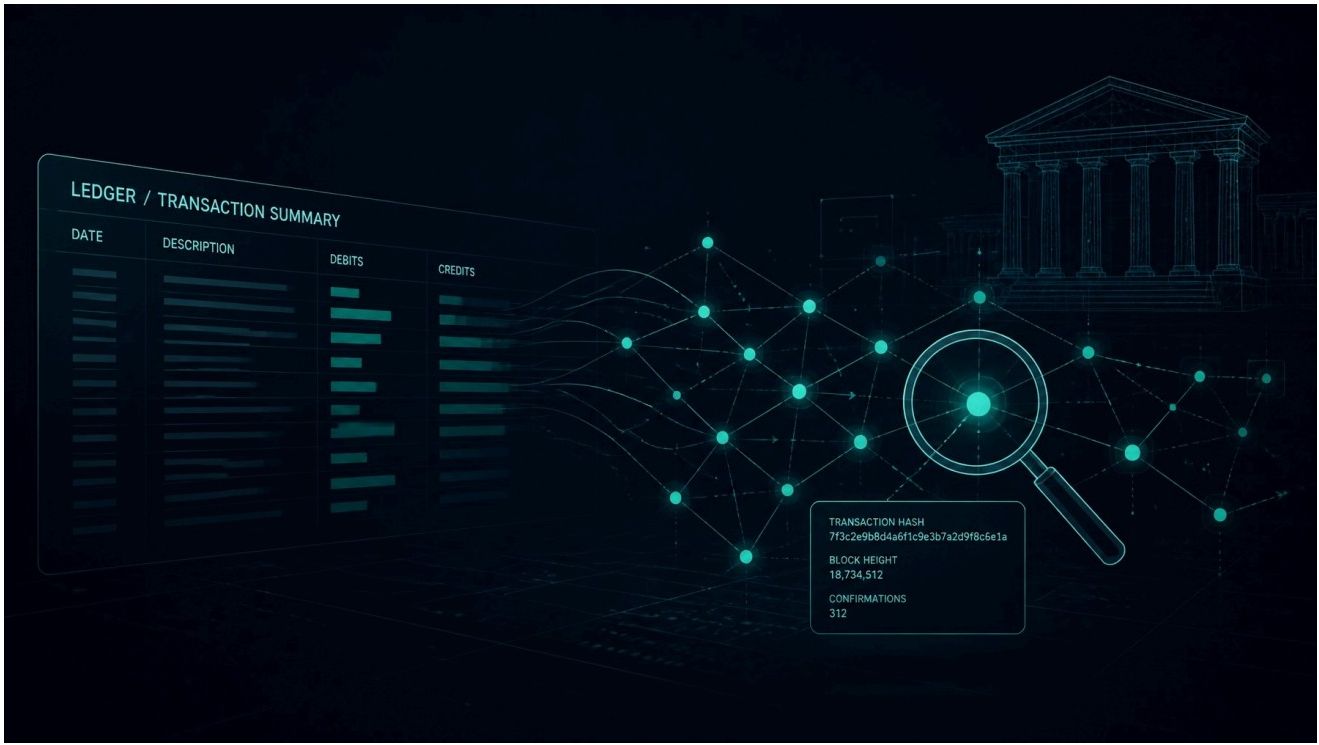
Stolen crypto recovery is often described like a chase scene: wallets sprinting across chains, hops multiplying, and the culprit disappearing into a mixer like it's a fog machine with an API.
Litigation doesn't run on chase scenes. It runs on accounting — structured schedules, defensible assumptions, identifiable source documents, and a clear methodology that survives cross-examination. Blockchain tracing is the raw telemetry. Crypto forensic accounting is how that telemetry becomes court-ready financial evidence.
This article explains how blockchain data is translated into financial statements suitable for court, how professionals separate narrative from digital evidence, and how follow-the-coin tracing differs from notional (pool-based) accounting when commingling or mixing destroys neat, coin-by-coin stories.
What Blockchain Shows (and What Courts Need)
A blockchain is a public ledger, but it's not a financial statement. On-chain data gives you transaction-level facts (hashes, timestamps, amounts, sender/receiver addresses, token contracts, gas fees), network-native context (block heights, confirmations, mempool timing, smart contract call data), and a visible flow graph (funds moving from address to address, sometimes into labeled services and sometimes into opacity).
Courts and counsel, however, typically need answers in accounting form: what assets were owned or controlled, and when? What was the source of funds (victim deposits, business revenues, marital funds, investor proceeds)? What was the use of funds (cash-out, reinvestment, transfers to insiders, purchases)? What is the loss model or damages computation, with explicit valuation methodology? What evidence is authenticated, preserved, and reproducible?
Blockchain Forensic Accounting: The Translation Layer
Think of crypto forensic accounting as a disciplined translation workflow: on-chain record (machine ledger) → accounting ledger (human ledger) → litigation exhibits (court ledger). A clean workflow usually separates outputs into three layers. Source artifacts (preservation targets): raw transaction data, wallet address lists, cluster notes and labeling rationale, exchange records (statements, trade logs, deposit/withdrawal history, KYC), banking records, and device artifacts. Accounting schedules: statement of crypto activity by wallet/account (beginning balance, inflows, outflows, ending balance), flow-of-funds schedules tying fiat → exchange → on-chain → service touchpoints → cash-out, valuation schedules (spot prices at relevant timestamps with methodology disclosed), and fee schedules. Court-facing exhibits: summary charts of movement with citations to hashes and records, demonstratives backed by reproducible schedules, and assumption disclosures.

Evidence Preservation: Methodology Before Conclusions
In high-value theft matters, the technical work is only half the battle. The other half is showing your work, cleanly. A useful anchor is the digital-evidence discipline described in Taylor et al. (2022) on preservation methodology for crypto wallets. In practice, modern preservation emphasizes identification (what devices, accounts, and services likely hold relevant artifacts), collection and acquisition (controlled capture of data, minimizing alteration), integrity controls (hashing, secure storage, access logging, repeatable acquisition steps), and chain of custody (who handled what, when, and how it was stored and transferred). For general digital forensic preservation principles, NIST SP 800-86 (PDF) remains a commonly cited baseline. The practical point for counsel: a brilliant trace with weak preservation is a fragile exhibit.
The Core Deliverable: From Transaction Hashes to Financial Statements
Forensic accounting outputs often resemble traditional financial schedules, but adapted to crypto's reality. A crypto general ledger by address or account is keyed to wallet address or exchange account, date/time (UTC plus explicit time zone handling), tx hash or internal exchange transaction ID, asset (BTC/ETH/USDT, etc.), quantity, USD value at time of transaction with valuation source disclosed, counterparty if known or labeled, and notes (for example, "deposit to Binance hot wallet cluster").
A flow-of-funds schedule (fiat ↔ crypto) is essential because stolen-crypto cases are rarely crypto-only. Victims often fund via bank wires to exchanges, card purchases, stablecoin purchases through VASPs, and OTC desks. A litigation-ready schedule ties off-chain records (bank statements, exchange statements) to on-chain confirmations (deposit tx, withdrawal tx). Holdings and control timelines often serve as the litigation hinge — when an address first received victim funds, when it began interacting with a service, whether activity patterns suggest custodial control vs. automated contract behavior, and when funds reached identifiable service touchpoints.

Follow-the-Coin vs. Notional Accounting (the Mixing Problem)
Follow-the-coin tracing means tracing specific on-chain movements hop-by-hop through addresses and transactions, producing a path narrative: Victim Address → Address A → Address B → Exchange Deposit Cluster → (possible off-chain conversion). Strengths: extremely concrete when the path is clean, strong demonstrative value, great for identifying service touchpoints where legal process may apply. Weaknesses: collapses under heavy commingling, breaks down when funds enter mixers or high-volume services, and can become overconfident if it treats heuristic assumptions as certainties.
Notional (pool-based) accounting treats a wallet or service as a pool of value and reconstructs balances and allocations using explicit accounting/legal rules rather than pretending each unit remained distinct. This is how traditional forensic accounting handles commingled funds in bank accounts. Strengths: survives commingling, better aligned to court-friendly damages modeling, forces explicit assumptions. Weaknesses: more assumption-driven, less visually clean than hop-by-hop tracing.
Complex Mixing Scenarios: What Notional Looks Like in Practice
When funds enter a mixer or high-velocity commingling environment, the best practice is usually to switch models rather than force a coin-by-coin fantasy. A disciplined report often does this: follow-the-coin up to the commingling boundary (identify the last clean wallets, document amounts, timestamps, and outputs entering the commingling service); define the commingling event (is it a mixer, an exchange hot wallet cluster, a bridge contract, or a DeFi pool, and what is the mechanism — pooled liquidity, many-to-many batching, UTXO aggregation, smart contract pooling); select an allocation rule explicitly (common notional approaches include pro rata allocation, FIFO/LIFO where supported by legal theory, and lowest intermediate balance concepts adapted carefully to crypto pools); and build schedules that show ranges and confidence (a conservative allocation, a likely allocation with stated assumptions, and a bounded high-end allocation).
The difference is not "trace or don't trace," but where tracing ends and accounting begins — and whether that handoff is documented in a way a judge can follow.
What a Court-Ready Crypto Forensic Accounting Package Typically Contains
For high-value matters, counsel generally benefits from a package that cleanly separates narrative vs. digital evidence (who said what, inducement, representations vs. hashes, statements, exports, screenshots, KYC records, banking records), on-chain vs. off-chain records (transactions, contract interactions, token transfers vs. exchange ledgers, banking rails, identity records, communications), and fact statements vs. expert opinions ("Transaction 0x... transferred 12.5 ETH on 2026-01-12 14:03 UTC" vs. "Address cluster likely controlled by X due to [stated indicators]"). This partitioning matters because litigation pressure doesn't usually attack math first — it attacks process, integrity, and assumptions.

Strategic Questions Counsel Should Ask Early
Before anyone builds charts, ask questions that shape the accounting model. What asset was stolen — native coin, token, or stablecoin? Was there conversion (BTC→ETH, ETH→USDT, stablecoin→fiat)? What valuation dates matter legally — date of loss, dates of conversion, date of filing, date of judgment? Where are the service touchpoints — exchanges, payment processors, bridges, OTC desks? What is the commingling profile — clean direct transfers vs. batching vs. mixers vs. DeFi pools? What's the evidentiary posture — settlement leverage, TRO/freezing motion support, or trial exhibits? A strong investigation often looks less like "find the thief" and more like "build a ledger the court can rely on."
Closing: Recovery Is a Legal and Accounting Problem, Not Just a Tracing Problem
Blockchain analysis can reveal a sophisticated trail, but litigation wants a different product: a financially coherent, methodologically preserved, court-readable reconstruction of what happened. In stolen crypto recovery matters, the difference between a compelling story and an admissible, persuasive exhibit is usually clear preservation practices, transparent assumptions, and accounting-grade schedules that translate on-chain activity into the language courts already speak. That's not glamour. That's what wins motions.
If your matter needs accounting-grade reconstruction of on-chain activity, contact StonePath Investigations, LLC for blockchain analysis, crypto tracing, and investigative intelligence reporting designed to survive cross-examination.
Schedule a Free Consultation