The "Recovery Hacker" Trap: Why a Licensed PI Is Your Only Real Defense Against a Second Scam
The immediate aftermath of a cryptocurrency theft is characterized by a state of heightened urgency and psychological vulnerability. For many victims, the realization that assets have been misappropriated from a digital wallet triggers an instinctive search for immediate solutions. In this volatile environment, a secondary predatory market flourishes: the "recovery hacker" scam. These entities, often found on social media platforms and forums like Reddit, present themselves as technical saviors capable of "hacking back" lost funds. However, the reality of digital asset recovery is governed by the immutable nature of the blockchain and the rigors of legal jurisdiction — two domains where anonymous "hackers" possess no authority and provide no security.
The distinction between a professional investigator and a recovery scammer is not merely a matter of technical skill, but rather a fundamental difference in legal standing, accountability, and methodology. For those seeking to address digital asset loss, understanding the mechanics of the "double scam" is the first step toward genuine forensic resolution.
The Anatomy of the Secondary Scam
The "recovery hacker" trap typically follows a predictable sequence designed to exploit the victim's hope and lack of technical familiarity with blockchain protocols. These actors often deploy automated bots to monitor keywords such as "crypto stolen" or "scammed" across social media. Once contact is established, the narrative follows a structured path of inducement.
The first stage involves the promise of high-certainty recovery. These individuals often claim to have "backdoor access" to exchanges or proprietary "software tools" that can reverse transactions — claims that are technically impossible given the decentralized architecture of most blockchains. What digital asset was sent? What was promised in return? In the scammer's narrative, the answer is always a swift return of funds, contingent upon an "upfront fee" for software licenses, "gas fees," or "activation protocols."
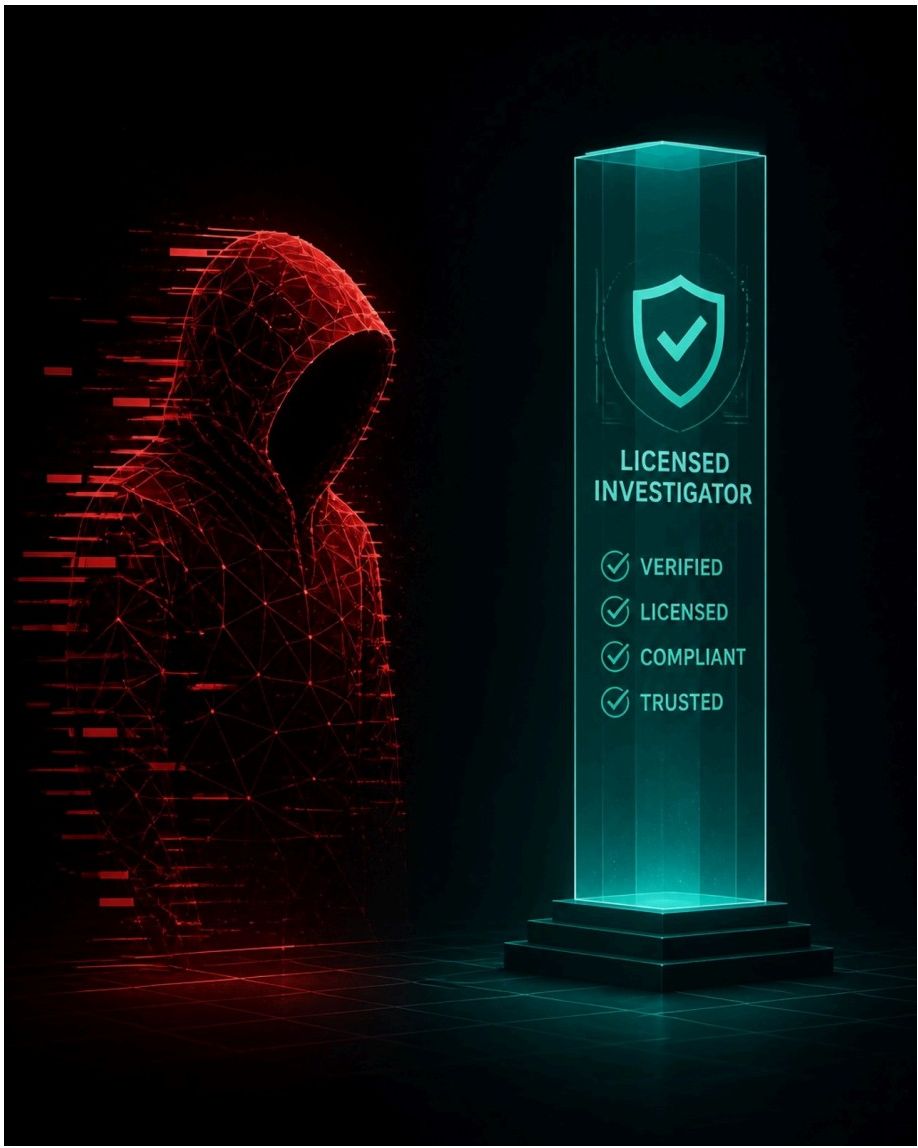
This "double scam" is particularly damaging because it leverages the initial loss to extract further capital. Unlike a legitimate blockchain investigation, which focuses on documenting the flow of funds for legal action, the recovery hacker focuses on the psychological manipulation of the victim. Once the initial "recovery fee" is paid, the scammer frequently identifies "new complications" that require additional payments, leading to a cycle of escalating financial loss without any progress toward asset retrieval.
The Credential Gap: Anonymity vs. Accountability
The most significant risk in engaging an unverified individual is the total absence of accountability. A "recovery hacker" exists only as a digital handle on an encrypted messaging app. They are not bound by professional ethics, state regulations, or insurance requirements. If they cease communication after receiving payment, the victim has no recourse.
In contrast, a Licensed New York State Private Investigator operates within a strict regulatory framework. At StonePath Investigations, LLC, our status as a licensed, bonded, and insured firm provides a level of protection that anonymous entities cannot replicate. This professional standing ensures that our crypto fraud investigations are conducted with a focus on admissible evidence and ethical conduct.
Consider the following distinctions between an anonymous entity and a professional firm: Regulatory Oversight — a licensed PI is vetted by state authorities, including background checks and adherence to professional standards; Contractual Transparency — professional services are governed by clear engagement letters detailing the scope of work, fee structures, and realistic expectations; Legal Utility — the documentation produced by a professional investigator is designed for use by law firms, law enforcement, and financial institutions, while a "hacker's" report holds no weight in a court of law.

Professional Methodology: The Strategy of Evidence
The core misconception regarding crypto asset recovery is the idea that funds can be "hacked" back into a victim's possession. In reality, the recovery process is an investigative and legal strategy, not a technical exploit. Legitimate blockchain transaction tracing involves a clinical analysis of wallet behaviors and fund flows to identify "service touchpoints" — instances where the stolen assets interact with centralized entities like exchanges.
What was the path of the transaction? Which exchange received the funds? A professional blockchain investigator utilizes specialized forensic software to map these movements with surgical precision. The goal is to produce a structured, court-ready report that documents the misappropriation and identifies the preservation targets. This intelligence-style reporting is essential for legal counsel to initiate the "off-chain" actions — such as subpoenas or freeze orders — required to actually recover assets.
The Risks of Upfront Fees and Unverified Claims
A hallmark of the "recovery hacker" is the demand for immediate, non-refundable upfront payments for vague technical services. While professional investigative firms often require a retainer — a standard practice in legal and forensic industries — the application of these funds is transparent and documented.
When evaluating a service provider, the absence of a verifiable physical address, a professional license number, or an insurance certificate should be viewed as a critical red flag. At StonePath Investigations, LLC, we prioritize the preservation of our clients' remaining capital by providing a realistic assessment of recovery potential. We do not offer guarantees of recovery because the final outcome often depends on variables outside an investigator's control, such as the responsiveness of foreign exchanges or the speed of law enforcement intervention. Instead, we offer a disciplined methodology that maximizes the probability of a successful legal outcome.
Navigating the Recovery Landscape Safely
For victims of cryptocurrency theft, the path forward must be defined by caution and a commitment to professional standards. To avoid the "Recovery Hacker" trap, consider the following strategic framework:
1. Verify Licensing. Ensure the investigator is licensed in their jurisdiction. In New York, this information is publicly accessible through the Department of State.
2. Request a Methodology Brief. A legitimate investigator should be able to explain their tracing process without relying on "secret" or "proprietary" hacking techniques.
3. Evaluate Professional Documentation. Ask to see the format of the final report. Is it designed for legal counsel, or is it merely a screenshot of a block explorer?
4. Confirm Insurance and Bonding. These are essential safeguards that protect the client in the event of professional errors or omissions.
The difference between a successful investigation and a secondary scam is not the complexity of the code, but rather the integrity of the investigator. By choosing a licensed professional, you are not just seeking your funds — you are securing a defense against further exploitation.
The Value of Clarity
The "Recovery Hacker" trap is a testament to the sophistication of modern digital crime, where the deception continues long after the initial theft. Engaging with anonymous entities on social media is not a solution; it is an amplification of risk. For high-net-worth individuals, law firms, and private clients, the priority must be the generation of high-quality intelligence and evidence.
If you have been the victim of a digital asset scam, do not let urgency lead to a second loss. Contact StonePath Investigations, LLC — a licensed, bonded, and insured New York State firm — for a clinical assessment of your case.
Schedule a Free Consultation