The First 48 Hours After a $50K+ Investment Scam: Preserving On-Chain Evidence for the FBI and NYPD
By StonePath Investigations, LLC · NYS-licensed PI firm · CAMS, CFE, TRM CI
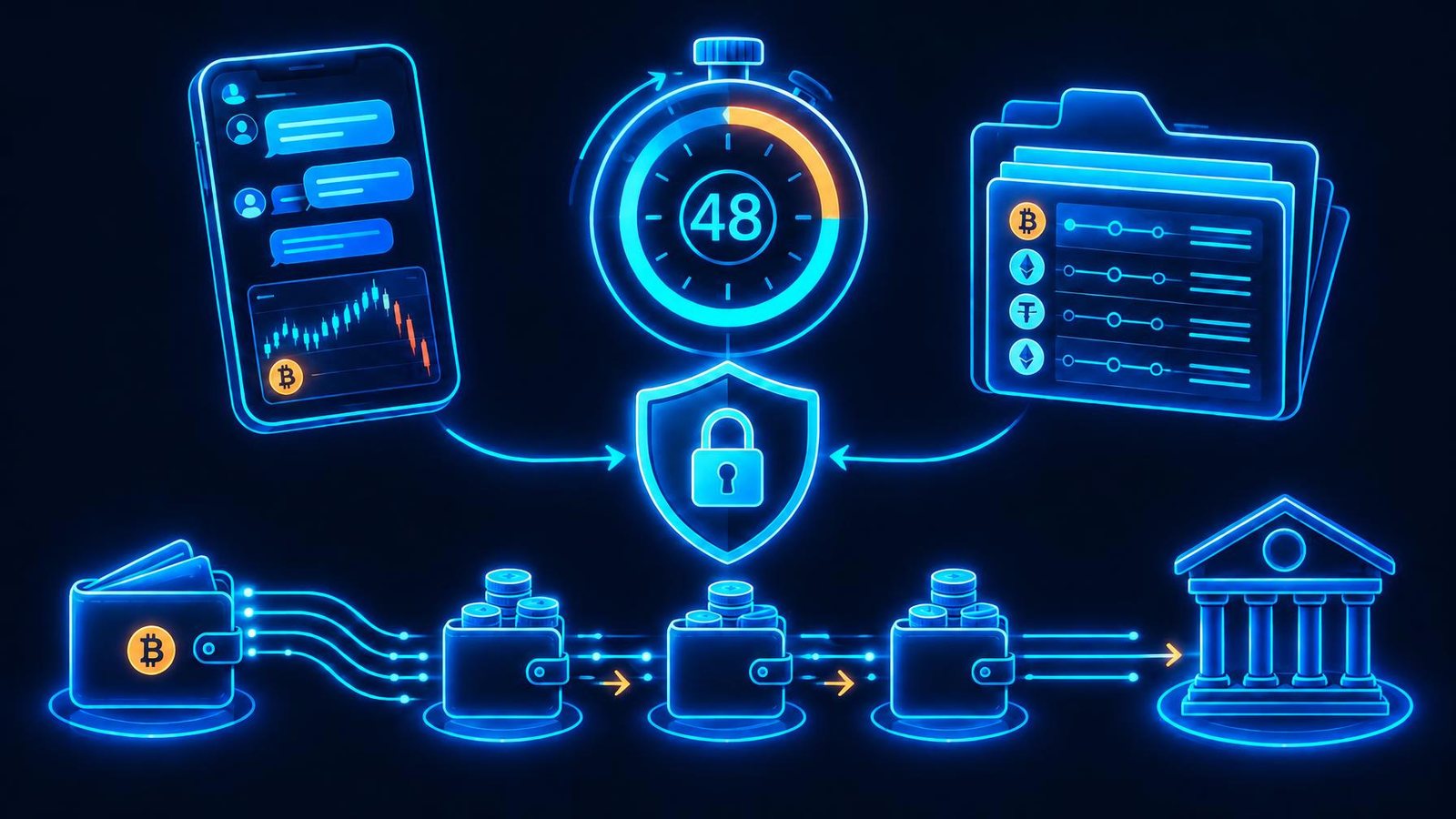
A crypto investment scam can leave two very different records: the story told in messages and on a fake investment platform, and the transactions permanently recorded on a blockchain. The first 48 hours are a practical window to preserve both, alert the institutions that may still have relevant records or control over funds, and prepare a clear report.
Speed matters, but it is not a recovery guarantee. A blockchain transfer can settle quickly, while an exchange or payment provider may need time and formal authority to locate records or act on a request. The window is useful because it helps preserve evidence and bring relevant institutions into the picture before accounts, websites, or contact channels become harder to access.
The FBI’s 2025 IC3 Annual Report recorded 61,559 reported cryptocurrency investment-fraud complaints and $7.228 billion in reported losses. Those figures describe complaints received by IC3-not every victim or every loss.
Preserve evidence before accounts disappear
Keep the original device and accounts intact where possible. Do not delete the messaging app, chats, emails, or investment platform. Avoid resetting your phone or editing original files. If you need to secure an account, preserve relevant records first if you can do so safely, then change credentials from a trusted device.
For each item, note when and how you collected it. Keep an untouched copy and make a separate working copy. This simple discipline helps preserve context and makes later review more reliable.
Chats and contact details
Preserve: Full chat exports where available; screenshots of important exchanges; usernames, profile links, phone numbers, email addresses, group names, and voice messages.
Why: The messages may document the inducement: who made the investment claims, what returns were promised, which account or wallet was supplied, and how the scammer responded to withdrawal requests. Capture the original contact method and any later move to another app.
The investment platform and advertised returns
Preserve: The full website address, app name, account identifiers, screenshots of balances and claimed profits, withdrawal screens, fee demands, and the advertisement, referral link, or social-media post that led you there.
Why: A displayed balance is not proof that assets exist. It is evidence of what the platform represented to you. Keep URLs, timestamps, and account identifiers visible; a cropped image of a large “profit” number is less useful without context.
Transaction hashes and wallet addresses
Preserve: Every transaction hash or transaction ID, sending and receiving address, asset and amount, date and time, and blockchain network. Include exchange withdrawal confirmations and deposit records. Copy addresses directly from the original transaction record; do not retype them from screenshots.
Why: The transaction hash identifies a specific on-chain transfer. The wallet address identifies a blockchain endpoint, not necessarily its owner. Keep the network with each address: similar-looking assets can exist on different chains, and a transaction on one network is not interchangeable with a transaction on another.
Fiat records and account records
Preserve: Bank statements, wire confirmations, card statements, payment-app records, exchange account statements, and correspondence with the institution that processed each payment.
Why: A useful investigation follows the whole path: money leaving a bank or card account, arriving at an exchange or payment service, and then being converted or transferred on-chain. The fiat leg may identify a service touchpoint even when a wallet’s controller is unknown.
Contact history and reporting
Preserve: A dated log of calls, emails, support tickets, complaint submissions, and case or reference numbers. Record the name of each institution or agency contacted and what you asked it to preserve or review.
Why: This gives investigators and counsel an organized record of actions already taken and helps avoid repeated, inconsistent explanations.
What the on-chain path may show
An investment scam may direct a victim to send assets to a deposit wallet. Funds may then be consolidated with transfers from other victims, swapped into another asset, routed through a bridge, or moved toward an exchange or other service. Some flows split into smaller transfers. A pattern often called a peel chain. These are possible patterns, not a template every scam follows.
Victim transfer
      |
      v
Deposit wallet       -- early review / preservation opportunity
      |
      v
Consolidation wallet(s)
      |
      +----> Asset swap or cross-chain bridge
      |                        |
      v                        v
Further transfers --> Exchange or other service touchpoint
                                     |
                                     +-- possible account records or hold, subject to
                                         the service’s policies and applicable authority
A blockchain record can show movement between addresses; it does not, by itself, identify a person or prove who controlled a wallet. A service touchpoint may offer a route to records or intervention, but whether funds remain there and whether action is possible depends on the circumstances. A trace is a map of evidence, not a verdict.
Reporting options for New York victims
File with IC3
Submit a complaint through the FBI’s Internet Crime Complaint Center. The FBI advises victims to include cryptocurrency addresses, transaction hashes, amounts and asset types, dates and times, how they encountered the scammer, communication platforms, website domains, phone numbers, and exchange information. File even if you do not yet have every transaction detail; add what you can verify.
The FBI’s cryptocurrency-scam guidance says not to wait to report and warns that people offering recovery for an upfront fee may be running another scam. An IC3 complaint creates a record and may be shared with law enforcement partners. It does not guarantee that an investigation will be opened or funds returned.
Contact local police and the appropriate prosecutor’s office
For a New York City report, contact your local NYPD precinct; use 911 for an emergency or crime in progress. The NYPD’s Detectives page provides information about its investigative units. If the matter concerns Manhattan, the Manhattan District Attorney’s Office lists its Financial Frauds Bureau at 212-335-8900 and provides financial-crime victim information. For other counties, check the relevant district attorney’s official website.
The grading question matters more than victims expect. New York larceny is graded by value: grand larceny in the second degree under Penal Law § 155.40 covers property valued above $50,000, and grand larceny in the first degree under Penal Law § 155.42 covers property valued above $1 million. Charging decisions belong to prosecutors, but the thresholds explain why a documented loss figure with dated transactions carries weight. It is the fact that places a complaint in a particular tier, and it is usually the first number a detective or assistant district attorney asks for.
Notify banks, card issuers, exchanges, and payment providers
Contact every institution involved in a fiat transfer or crypto transaction promptly. Ask whether a transfer can be recalled or a pending transaction stopped, and ask the institution to preserve relevant account and transaction records. For an exchange, provide the transaction hash, network, asset, amount, timestamps, and your related account records. Make a written support request and keep the ticket number. An institution may require law-enforcement or legal process before disclosing customer records or taking certain actions.
If the matter involves a New York-regulated financial or virtual-currency business, the NYDFS Consumer Complaint Portal accepts complaints about virtual-currency businesses and other financial services. NYDFS lists its consumer hotline as 800-342-3736. Check a company’s authorization through the department’s virtual currency business licensing information; a license does not validate an investment or guarantee a platform’s claims.
Build a package someone else can use
A folder of screenshots is a starting point, not an evidence package. Organize the material so a reviewer can understand what happened and verify the digital trail:
1. Incident timeline: First contact, key investment claims, account setup, each payment, withdrawal attempts, fee demands, and discovery of the suspected fraud.
2. Transaction schedule: One row per transfer, with date and time (including time zone), asset, amount, network, sending and receiving addresses, transaction hash, and linked exchange or bank record.
3. Service-touchpoint list: Exchanges, payment services, bridges, websites, apps, and other identifiable services along the route. Distinguish a verified service from an unconfirmed attribution.
4. Narrative summary: Separate what was promised from what was sent. Identify which facts come from messages, platform screens, bank records, or blockchain data.
5. Preservation log: List original files, collection dates, copies provided, and the recipient of each copy.
A disciplined investigative methodology, like the evidence organization described in StonePath Investigations’ crypto-fraud investigation overview, keeps the narrative, transaction schedule, and source records tied together. The long-term value is clarity: another reviewer can follow the path without relying on memory or guesswork.
Watch for the second approach
After an investment scam, victims may be contacted by someone claiming to be a recovery agent, investigator, lawyer, or government official. Be cautious of upfront “tax,” “unlock,” or “release” fees, guaranteed recovery claims, and requests for seed phrases, private keys, passwords, or one-time codes. Do not confront the suspected scammer or send additional funds to test a withdrawal. Preserve the new contact as evidence and verify any claimed affiliation through an independently located official channel.
Set expectations, and identify when to get help
Reporting is necessary; it is not the same as an investigation or recovery. A freeze is not a return of assets, and the possibility of action depends on where funds moved, whether they remain at an identifiable service, and what authority is available. No blockchain trace can promise a particular outcome.
For a substantial loss, an identified exchange or other service touchpoint, or contemplated litigation, counsel may decide that specialist blockchain analysis is useful. An investigator can help organize transaction evidence and distinguish documented facts from analytical inferences; legal counsel determines legal strategy and process. The immediate objective is to preserve a usable record that remains valuable whether the next step is a bank review, law-enforcement assessment, or civil action.
This article is educational and is not legal advice.
If you lost $15,000 or more in a crypto investment scam, the evidence you preserve now shapes what law enforcement can act on. Contact StonePath Investigations, LLC to discuss an intelligence report prepared for the FBI, NYPD, and other agencies.
Schedule a Free ConsultationReferences
- FBI, 2025 IC3 Annual Report
- FBI IC3, Cryptocurrency
- NIST SP 800-86, Guide to Integrating Forensic Techniques into Incident Response, the standard framework for preserving digital evidence described above
- FBI IC3, Guidance for Cryptocurrency Scam Victims
- FDIC Office of Inspector General, Pig Butchering Scams
- Manhattan District Attorney’s Office, Financial Crimes
- New York Penal Law § 155.40, Grand larceny in the second degree and § 155.42, Grand larceny in the first degree, New York State Senate consolidated laws
- New York Department of Financial Services, File a Complaint
- New York Department of Financial Services, Virtual Currency Business Licensing
- NYPD, Detectives