Cryptocurrency in New York Surrogate's Court: Locating Undisclosed Digital Assets in Estate Probate
By StonePath Investigations, LLC · NYS-licensed PI firm · CAMS, CFE, TRM CI
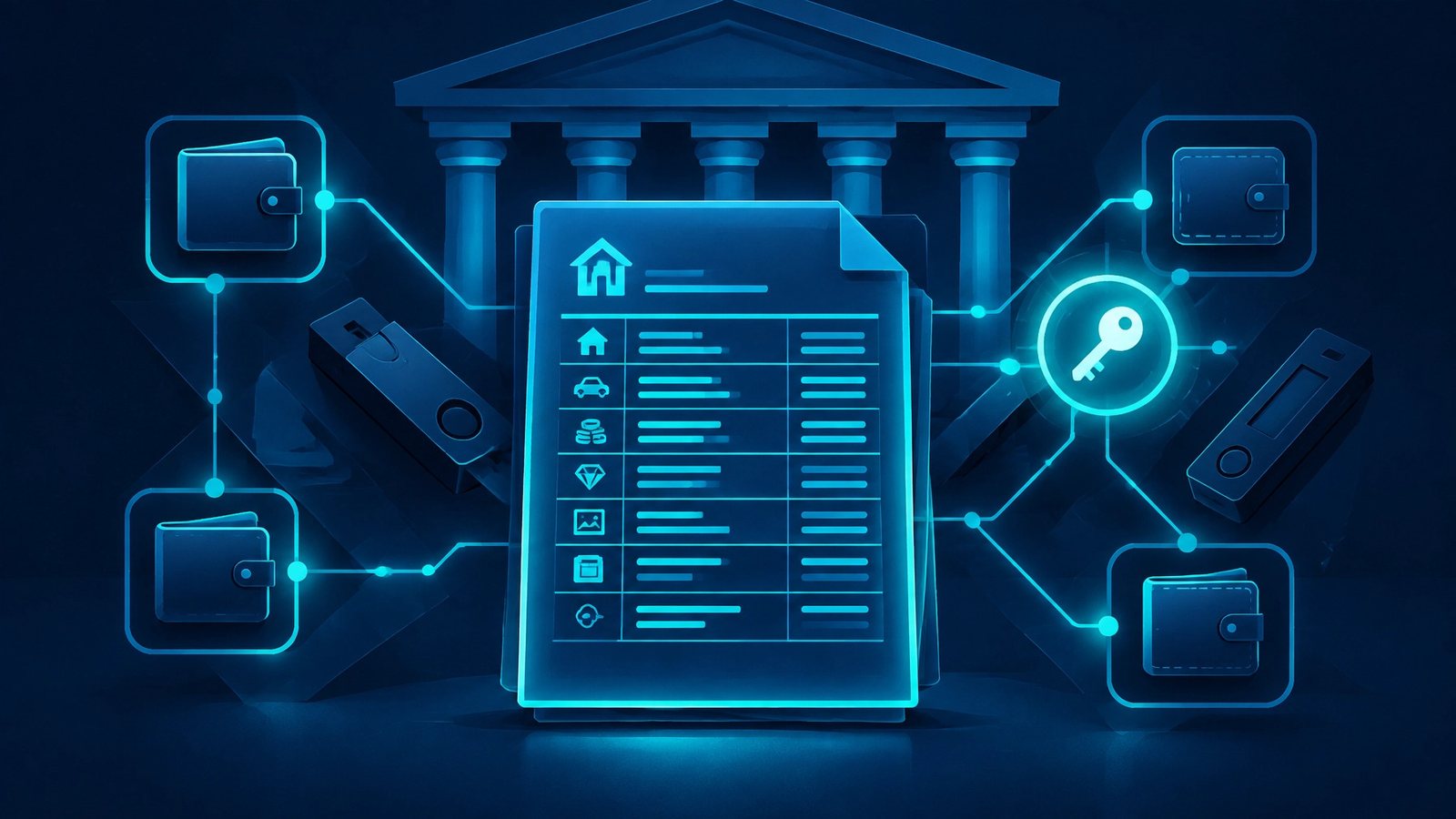
A decedent's estate inventory lists bank accounts, brokerages, real property, and personal effects. It almost never lists a hardware wallet in a drawer, an exchange account under an email address the family did not know about, or a stablecoin balance sitting in a lending protocol.
That gap is becoming a routine problem for New York estate practitioners. Digital assets are simultaneously easy to hide, easy to lose, and increasingly common. The consequence for fiduciaries is a two-part challenge: locating holdings that never appeared in any statement, and establishing legal access to holdings that exist only as cryptographic key material.
The two problems have different solutions, and confusing them wastes months. Here is the map.
Why the standard inventory misses digital assets
A conventional estate inventory is built from documents the fiduciary can find: statements, tax returns, property records. Crypto resists each of those sources.
Exchange accounts produce statements, but only if the fiduciary knows the account exists and which platform holds it.
Self-custody wallets produce nothing. There is no custodian, no statement, and no institution to ask.
DeFi positions exist as smart-contract state: lending balances, staked tokens, liquidity-pool positions. They appear on no statement unless the decedent documented them.
Stablecoins can hold substantial value while never touching a bank account.
Tax filings may report digital-asset gains without identifying where the assets sat, and often without the decedent having disclosed them anywhere else.
The practical consequence: an estate can be administered, distributed, and closed while material value sits unnoticed, or while heirs argue over holdings the fiduciary never found.
The custody structure determines everything
Every digital asset in an estate sits in one of a few custody structures, and each implies a different access path:
Custodial exchange accounts. A third party holds the assets. Access requires probate authority and the platform's process: letters testamentary or letters of administration, a death certificate, and identity verification from the personal representative. Some platforms require additional documentation or a court order. The fiduciary should also check whether the decedent designated any beneficiary or nominated contact on the platform, because provider-designated mechanisms can interact with fiduciary authority.
Self-custody wallets. The estate holds the assets only if it holds the key material: seed phrases, private keys, hardware devices, or backup documentation. Without them, the assets are cryptographically inaccessible, and no court order changes that. This is the category where estates lose value permanently.
Multisignature arrangements. If the decedent was one signer among several, access may depend on other signers' availability and cooperation. The estate plan may not have addressed what happens when a signer dies.
DeFi positions. Access runs through the controlling wallet. Legal authority to an exchange account does not reach a lending position; the wallet does.
New York's statutory framework for fiduciary access to digital assets, EPTL Article 13-A, which adopted the Revised Uniform Fiduciary Access to Digital Assets Act, gives executors and administrators a legal basis to direct a custodian to disclose and manage a user's digital assets, within a layered framework of user direction, tool settings, and terms of service. It is essential reading for the access question, and equally essential to understand its limit: the statute reaches custodians. It does not reach private keys. A self-custodied asset is governed by cryptography, not by statute.
Red flags executors should test, not assume
The estate's paper trail usually contains hints the fiduciary can act on:
Tax filings showing digital-asset transactions, Form 8949 entries, or Schedule D digital-asset gains without any disclosed account;
Bank or card records showing wires to exchange deposit addresses, recurring small transfers to unfamiliar counterparties, or withdrawals of cash near known exchange locations;
Email confirmations from exchanges, wallet providers, or crypto tax software;
Physical evidence: hardware devices, seed-phrase backup cards, printed recovery sheets, USB drives;
Cloud artifacts: password-manager entries, authenticator applications, browser wallet extensions;
Communications referencing trading, mining, or investments in digital assets.
Each flag is a lead to test, not proof of a holding. The analytic question is the same one an investigator asks anywhere: what was documented, what was actually held, and where is the gap between them?
What a trace produces for an estate
Where paper clues point to possible holdings, on-chain analysis can map what the decedent actually controlled:
Wallet clusters plausibly controlled by the decedent, with methodology stated;
Exchange touchpoints where funds entered or exited, identifying the platforms to approach for access;
Balances and positions by asset, network, and custody type, as of a valuation date;
Transfer chronology in the years before death, which helps distinguish assets from dispositions already made;
Documentation of value for the estate's accounting, with the legally relevant valuation dates identified: date of death, and any alternate valuation date the election rules permit.
Date discipline matters in estates as much as in divorces. The value on the date-of-death inventory is not the value today, and a defensible schedule shows the units held, the asset, the network, and the price source, not just a number.
The trace gives the fiduciary a factual asset map before the access question is resolved. It does not create access. It tells the estate where to look, what to claim, and what to preserve.
Preservation before interpretation
Digital-asset evidence degrades fast, and estates have their own clock. Devices get wiped, cloud accounts get memorialized or deleted, exchanges purge inactive data under their own policies, and a single well-meaning relative with the decedent's phone can destroy the key material everyone is looking for.
Practical preservation rules:
Secure devices immediately. Hardware wallets, phones, computers, and backup media should be imaged or inventoried without attempting logins that could trigger device wipe or account changes.
Never share seed material. Whoever handles recovery documentation should not photograph it, forward it, or retype it. Treat it like the asset itself.
Document chain of custody for every device and export: who handled it, when, and what was done.
Do not move assets before counsel confirms authority. A premature transfer out of a decedent's wallet raises fiduciary and tax questions and can destroy the evidentiary record of what was held.
Check exchange data-retention posture early, because some platforms require prompt action on inactive accounts.
Surrogate's Court mechanics, briefly
Where holdings surface, the fiduciary's obligations follow Surrogate's Court practice:
Amend or supplement the inventory to include located assets;
Use the court's discovery procedures, including the disclosure devices available under the SCPA's discovery and examination provisions, to obtain records from custodians and third parties;
Address valuation questions for volatile assets, documenting the methodology;
Account for located assets and report distributions to beneficiaries with the same date discipline applied to any other asset.
Where assets are located but access is disputed, turnover proceedings may be required. Where assets are located but keys are lost, the fiduciary's obligation is documentation of the loss and the search, which protects the estate from later challenge.
The lesson for living clients
Every executor reading this article is reading the failure mode of someone's estate plan. The prevention is unglamorous and effective:
A documented schedule of digital-asset holdings, updated periodically;
A decision about custody: custodial platforms with known succession processes, or self-custody with documented, locatable recovery materials;
Fiduciary directions in the estate documents consistent with EPTL Article 13-A's framework;
For multisig holders, a succession plan for the signer set;
Storage of recovery material in a way the executor can actually find, without compromising security while the owner is alive.
A tracing methodology converts an undocumented holding into a mappable one; it cannot convert a lost key into access. The approach StonePath Investigations applies to crypto investigations, documenting digital-asset holdings for estates and fiduciaries, follows that discipline. Planning is the part that happens while the client can still act.
Honest limits
Tracing locates; it does not conjure. If the decedent held self-custodied assets and left no key material, the assets may be permanently inaccessible regardless of the estate's legal authority, and the fiduciary's duty may be satisfied by documenting a diligent search. Exchange processes vary in documentation demands and timelines. And this article is educational context for practitioners, not legal advice; the statute and the court's rules are the controlling authorities.
If an estate you administer may hold undisclosed digital assets, the trace and the preservation steps should start before the inventory is final. Contact StonePath Investigations, LLC to discuss litigation-ready forensic blockchain analysis for fiduciaries and estate counsel.
Schedule a Free ConsultationReferences
- New York Senate, EPTL Article 13-A, Fiduciary Access to Digital Assets
- New York Public Law, EPTL Article 13-A text
- EPTL § 13-A-2.2, Disclosure of content of electronic communications of deceased user, the fiduciary-access provision for a deceased user's communications
- EPTL § 13-A-3.1, Disclosure of other digital assets of deceased user, the provision governing access to records beyond communications content
- SCPA § 2103, Discovery and SCPA § 2104, Examinations, the Surrogate's Court disclosure devices referenced above
- SCPA Article 21, Cornell LII, for confirming current text before filing
- New York State Bar Association, estate and trust practice resources
- Morgan Legal Group, “Digital Assets & Estate Planning in New York: 2026 Guide”
- Moye Law, “Fiduciary access to digital assets in New York,” June 2026
- EstateMin, “How to Handle Cryptocurrency in Probate, NYC,” May 2025